
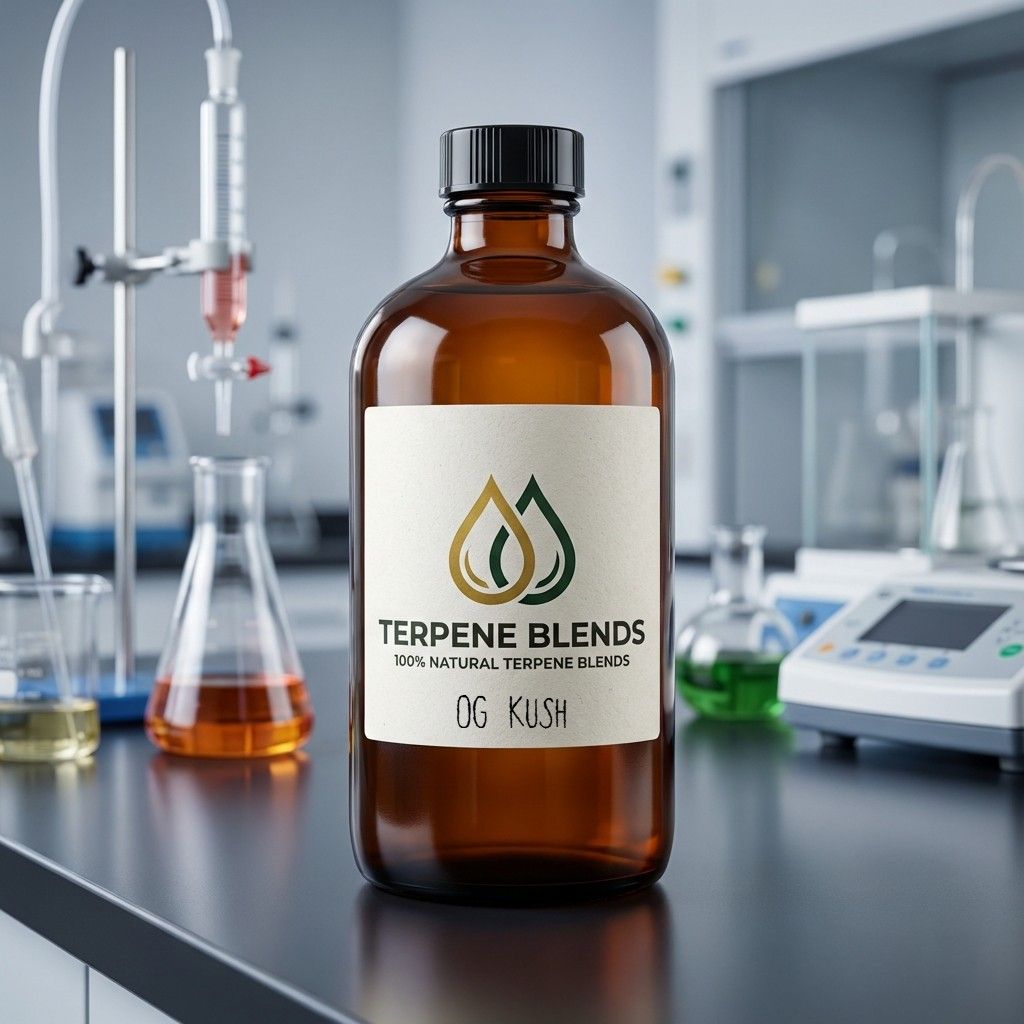
OG Kush Terpene Blend – Aroma Profile, Flavor Notes, and Formulation Guide
OG Kush is one of the most instantly recognizable aroma profiles in the terpene industry — a complex, fuel-forward signature layered with earth, pine, and a subtle citrus bite that has made it a benchmark for formulators worldwide.
Its distinctiveness and mass-market familiarity make it a perennial top choice for product developers seeking a bold, confident scent identity.
As a botanical terpene blend, OG Kush delivers that iconic character in a consistent, THC-free, solvent-free format built for professional formulation.
A Brief History of OG Kush
Few names in cannabis culture carry as much weight as OG Kush. Believed to have emerged in Florida in the early 1990s before making its way to California, OG Kush quickly became a cornerstone of the West Coast cannabis scene. Its exact genetic lineage has been debated for decades — some attribute it to a cross between Chemdawg and a Hindu Kush landrace, while others point to additional influences from Lemon Thai. Regardless of its precise origins, OG Kush established a flavor and aroma standard that the industry still measures itself against today.
By the mid-1990s, OG Kush had taken root in Los Angeles and was spreading rapidly through cultivation circles who prized its unusually pungent, multi-layered scent profile. It became a foundational genetic in Southern California, spawning dozens of derivative cultivars that have shaped modern strain development. Its cultural footprint extended far beyond horticulture — OG Kush became embedded in music, fashion, and popular culture as shorthand for quality and authenticity.
Today, OG Kush's legacy is most powerfully felt in the aroma and flavor industry. As a reference point for terpene formulators, it represents the gold standard of a fuel-meets-earth-meets-citrus aromatic architecture. Botanical blends inspired by OG Kush allow manufacturers to capture that legacy in a scalable, plant-derived format that requires no cannabis sourcing, no licensing complexity, and no variability from harvest to harvest.
Aroma & Flavor Characteristics
The OG Kush aroma profile is layered and assertive, with enough complexity to anchor a formulation or carry a product line on its own:
- Fuel / petroleum — a sharp, hydrocarbon-forward note that defines the top of the scent profile
- Earthy / woody — a deep, damp-soil base that grounds the more volatile top notes
- Pine / forest — a crisp, resinous middle note adding brightness and structure
- Citrus / lemon zest — a subtle but detectable brightness that lifts the overall profile
- Spice / pepper — a dry, warm undercurrent that adds complexity and depth
- Herbal / skunky — a pungent, vegetal quality that gives the blend its unmistakable edge
Terpene Profile Breakdown
Myrcene — The most abundant terpene in many OG Kush expressions, myrcene contributes a ripe, musky earthiness with subtle fruit undertones. It provides the dense, heavy base note that gives this profile its characteristic weight and depth.
Limonene — Responsible for the bright citrus lift that cuts through OG Kush's heavier notes, limonene brings a clean lemon-peel sharpness to the overall blend. It plays a critical role in keeping the profile from becoming too flat or one-dimensional.
Caryophyllene — This terpene introduces the dry, peppery spice note that adds structural complexity to the OG Kush aromatic architecture. Its warm, woody character bridges the fuel and earth notes with seamless continuity.
Pinene — Contributing the crisp, resinous pine quality that many associate immediately with OG Kush, alpha-pinene sharpens the mid-register of the profile and adds a fresh, forest-floor clarity. It also reinforces the herbal edge of the overall blend.
Linalool — Present in smaller concentrations, linalool adds a faint floral softness that rounds out the harder edges of the fuel and pepper notes. It prevents the profile from reading as overly harsh and gives it a subtle elegance beneath the boldness.
Why Strain-Inspired Terpene Blends Matter
Working with living plant material — even in controlled cultivation environments — introduces inherent variability. Factors like soil composition, light cycles, humidity, harvest timing, and post-harvest handling all influence the final terpene expression of any given batch. For manufacturers building products that require batch-to-batch consistency, that variability creates real formulation challenges. A botanical terpene blend inspired by OG Kush eliminates those variables entirely, delivering the same aroma fingerprint on every order.
Scalability is another critical advantage. A manufacturer producing thousands of units per month cannot rely on a supply chain tied to seasonal harvests or cultivation yields. Botanical terpene blends are produced from a diverse range of plant sources — citrus, herbs, conifers, and spices — making them far more supply-stable than cannabis-derived alternatives. For high-volume manufacturers, that stability is not a minor convenience; it is a prerequisite for professional operation.
Finally, the regulatory simplicity of botanical blends cannot be overstated. THC-free, solvent-free, and compliant across all 50 states, a botanical OG Kush blend can be incorporated into product lines without triggering the licensing, testing, or distribution restrictions associated with cannabis-derived materials. For formulators working in mainstream consumer goods, cosmetics, or food-adjacent categories, that compliance profile opens doors that cannabis-derived terpenes simply cannot.
Best Applications for OG Kush Terpene Blend
Vape Cartridges — OG Kush is one of the most requested aroma profiles in the vape category, where its fuel-and-earth character translates powerfully into vapor form. The bold terpene profile holds up well at vaporization temperatures, making it a natural fit for cartridge formulations where a strong, recognizable scent signature is a product differentiator.
Pre-Roll Products — For hemp and botanical pre-roll manufacturers, OG Kush terpene blend adds an authentic, heritage-strain aromatic character to the finished product. Applied during the blending or infusion stage, it allows manufacturers to deliver a consistent scent experience across every unit in a production run.
Edibles and Confections — The citrus and earthy notes of OG Kush translate well into gummy, chocolate, and hard candy formats where a complex, slightly herbal flavor profile is desirable. Formulators working in the edible space appreciate its distinctiveness as an alternative to conventional fruit or mint flavor systems.
Beverages — At lower use rates, OG Kush terpene blend can introduce subtle earthy, citrus, and pine notes into craft beverages, sparkling waters, and functional drink formats. Its complexity makes it a compelling choice for beverage developers seeking a profile that reads as sophisticated rather than straightforwardly sweet.
Candles and Home Fragrance — The bold, resinous character of OG Kush makes it an exceptional choice for candle and home fragrance applications, where its fuel, pine, and earth notes create a distinctive atmosphere without reading as conventional or generic. It performs well in both cold throw and hot throw applications.
Personal Care and Cosmetics — Formulators in the skincare and body care space can leverage OG Kush's complex, woody-citrus profile as a signature fragrance note in lotions, balms, serums, and grooming products. Its association with a premium, heritage identity gives finished products a compelling aromatic backstory.
Aromatherapy Products — As an aroma-only application, OG Kush terpene blend performs well in diffuser blends, reed diffusers, and room sprays where its multi-layered character creates a rich, enveloping scent environment. Its depth and complexity make it a standout in aromatherapy product lines seeking differentiation from floral or simple citrus profiles.
Food Flavoring — In culinary applications where earthy, herbal, and citrus notes are desirable — such as specialty sauces, seasonings, or craft food products — OG Kush terpene blend offers a distinctive flavor identity. Formulators should test at low inclusion rates to calibrate intensity to the specific application.
Formulation Tips for OG Kush
- Use at 1–5% by weight — Begin at the lower end of this range and titrate upward based on the desired intensity in your specific base material. OG Kush's fuel and earth notes can become overwhelming at higher concentrations in light-bodied bases.
- Test in small batches first — Always run small-scale trials before committing to full production runs. Aroma interaction with base materials can shift the perceived scent profile in unexpected ways.
- Store in a cool, dark place away from heat and light — Terpene blends are sensitive to oxidation and thermal degradation; proper storage ensures the profile remains stable between uses.
- Keep the container tightly sealed between uses — Exposure to air accelerates oxidation of the more volatile top notes, which can cause the profile to flatten over time and lose its characteristic fuel brightness.
- Protect the citrus and pine top notes — Limonene and pinene are among the more volatile components of this blend. In high-heat applications such as baking or hot-process candle making, consider adding the blend at the lowest feasible temperature to preserve these top-note contributors.
- Pair with complementary earthy base notes — In complex formulations where OG Kush is layered with other flavor or fragrance elements, earthy and woody base notes such as cedarwood, vetiver, or patchouli will reinforce rather than compete with the blend's natural character.
The Difference Between Botanical and Cannabis-Derived Terpenes
Terpenes are produced by a vast range of plants throughout the natural world — citrus fruits, conifers, herbs, flowers, and spices all generate terpene compounds that are chemically identical to those found in cannabis. Botanical terpene extraction draws on this broader plant kingdom, isolating individual terpene compounds from non-cannabis sources and blending them to recreate the aromatic signature of specific strains. The resulting product is molecularly equivalent to its cannabis-derived counterpart but entirely free of the regulatory, supply chain, and compliance complications associated with cannabis sourcing.
Cannabis-derived terpenes, by contrast, require licensed cannabis plant material as their source, which introduces a range of practical limitations for professional manufacturers. State-by-state licensing requirements, limited supplier networks, harvest-dependent supply variability, and the potential for trace cannabinoid contamination all create friction in the formulation and distribution process. For manufacturers operating across multiple markets or producing at scale, these constraints can significantly complicate operations.
Botanical terpene blends resolve these challenges comprehensively. Because they are THC-free, solvent-free, and sourced entirely from non-cannabis botanicals, they can be shipped, stored, and incorporated into formulations without restriction across all U.S. states and many international markets. For professional formulators who need reliability, repeatability, and compliance built into every component they source, botanical terpene blends represent the clear professional standard.