
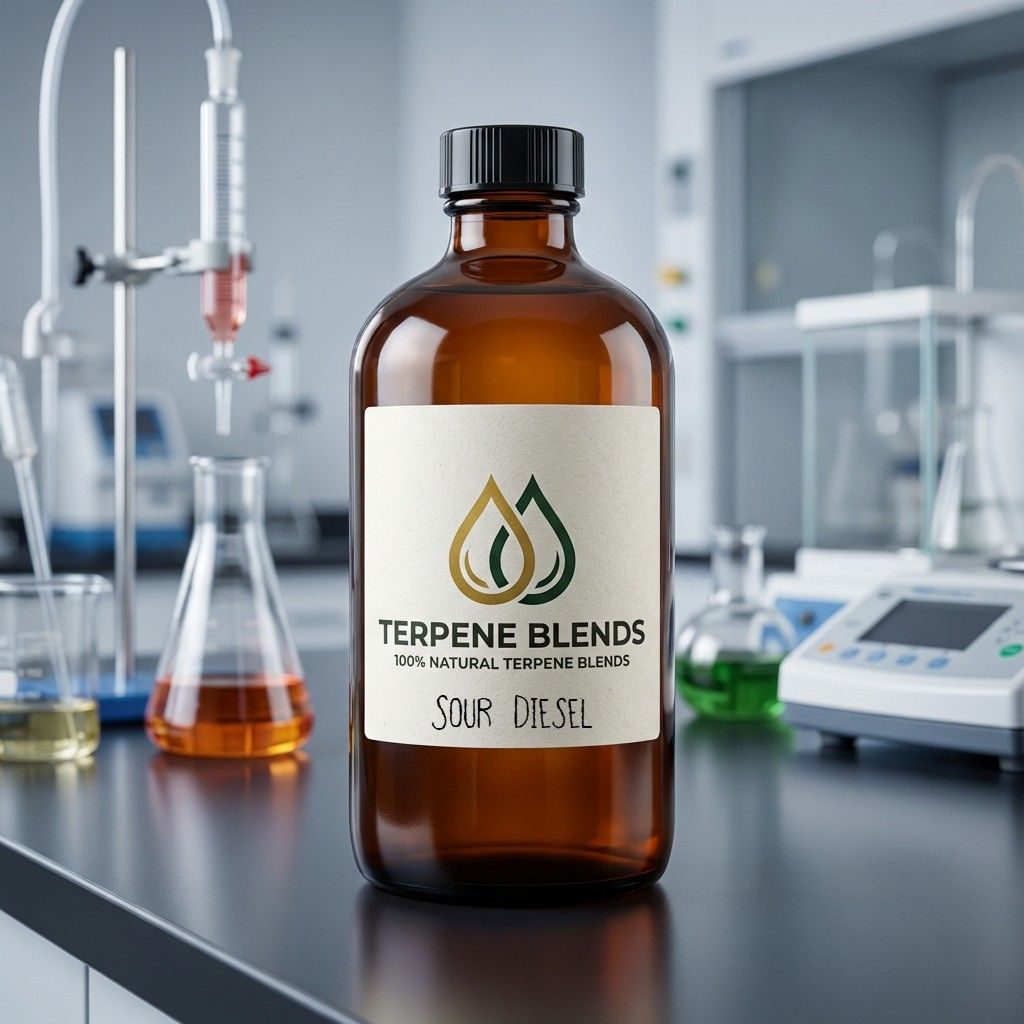
Sour Diesel Terpene Blend – Aroma Profile, Flavor Notes, and Formulation Guide
Sour Diesel is one of the most polarizing and immediately identifiable aroma profiles in the terpene industry — a sharp, fuel-driven signature cut through with bright citrus and a pungent herbal edge that has made it a cultural touchstone for decades.
Its aggressive, high-impact character makes it a compelling choice for formulators and product developers who want a profile that demands attention and delivers instant recognition. As a botanical terpene blend, Sour Diesel captures that legendary aroma in a consistent, THC-free, solvent-free format built for professional production environments.
A Brief History of Sour Diesel
Sour Diesel emerged in the early 1990s on the East Coast of the United States, with New York City widely credited as its point of origin. Its precise genetic lineage has been the subject of considerable debate among cultivators and historians, with the most commonly cited origin story pointing to a cross between Chemdawg 91 and Super Skunk, potentially with Massachusetts Super Skunk or Northern Lights genetics also in the mix. What is less debated is the speed with which it spread — Sour Diesel's aggressive, fuel-forward aroma set it apart from virtually everything else available at the time, and word traveled fast.
By the mid-1990s, Sour Diesel had established itself as one of the premier cultivars on the East Coast, particularly in New York where it developed an almost mythological reputation. It became deeply embedded in the hip-hop and underground culture of that era, referenced in music and celebrated in social circles that valued its distinctive character above all else. That cultural cachet followed it westward as it spread to California and beyond, where it became a staple of dispensary menus and a benchmark against which other fuel-forward profiles were measured.
Today, Sour Diesel's legacy in the aroma and flavor industry is defined by its uncompromising character. It refuses to blend quietly into the background — it announces itself immediately and lingers with authority. For terpene formulators, that assertiveness is exactly the point. A botanical Sour Diesel blend gives manufacturers access to one of the most recognized and requested aroma profiles in the world, delivered with the consistency and compliance profile that professional production demands.
Aroma & Flavor Characteristics
Sour Diesel's aroma profile is aggressive, complex, and unmistakable. It is not a subtle profile — it leads hard and holds the room:
- Diesel / gasoline — a sharp, acrid fuel note that defines the profile's identity from the first impression
- Sour citrus — a tart, lemon-forward brightness that cuts through the heavier fuel base
- Pungent herbal — a green, vegetal quality that adds organic complexity beneath the top notes
- Earthy / damp — a subtle soil note that grounds the more volatile elements
- Skunky — a pungent, sharp edge that reinforces the profile's boldness
- Light floral — a barely-there softness in the far background that prevents the profile from reading as purely harsh
Terpene Profile Breakdown
Caryophyllene — The dominant structural terpene in many Sour Diesel expressions, caryophyllene contributes a dry, spicy, fuel-adjacent warmth that reinforces the profile's characteristic harshness. Its woody, peppery quality sits at the intersection of the diesel top note and the earthy base, giving the profile its cohesive backbone.
Myrcene — Myrcene provides the dense, musky earth base that anchors Sour Diesel's more volatile top notes and prevents the profile from reading as one-dimensionally sharp. Its subtle fruit undertones soften the diesel edge just enough to give the overall blend depth without compromising its aggression.
Limonene — Responsible for the sour, tart citrus note that gives this strain half of its name, limonene is a critical component of the Sour Diesel aroma architecture. Its sharp lemon-peel quality cuts through the heavier fuel and earth notes, providing the brightness that keeps the profile dynamic and multi-dimensional.
Pinene — Alpha-pinene contributes a crisp, resinous forest note that adds structural clarity to the mid-register of the Sour Diesel profile. It reinforces the green, herbal quality of the blend and prevents the fuel notes from completely dominating the overall character.
Ocimene — A less commonly discussed but important contributor to the Sour Diesel aromatic profile, ocimene brings a sweet, herbaceous, slightly tropical softness that adds nuance to the background of the blend. It provides an unexpected brightness that makes the profile feel more complex than a simple fuel-and-citrus construction.
Why Strain-Inspired Terpene Blends Matter
The terpene expression of any cultivar grown from living plant material is subject to a wide range of environmental and procedural variables — light intensity, soil nutrition, water quality, temperature fluctuation, harvest timing, and curing methodology all influence the final aroma profile that reaches the end of the supply chain. For manufacturers who need Sour Diesel to smell like Sour Diesel on every production run, that variability is an operational problem. Botanical terpene blends solve it by fixing the aromatic formula in place and reproducing it identically regardless of season, geography, or sourcing conditions.
Scalability compounds this advantage significantly. A manufacturer producing at meaningful volume cannot absorb the supply chain friction that comes with cannabis-derived terpene sourcing — licensed suppliers, state-by-state shipping restrictions, variable cannabinoid contamination risk, and harvest-dependent availability all create bottlenecks that botanical sourcing simply does not. Botanical Sour Diesel terpene blends are derived from a wide range of non-cannabis plant sources, making them supply-stable, consistently available, and free from the regulatory complexity of cannabis material.
For brands building long-term product lines around a Sour Diesel identity, botanical blends also provide a critical competitive advantage in consistency of brand experience. When a consumer or wholesale buyer knows exactly what a product smells like before they open it — because it has smelled exactly that way every single time — that predictability becomes a brand asset. Botanical terpene formulation is what makes that level of sensory consistency achievable at scale.
Best Applications for Sour Diesel Terpene Blend
Vape Cartridges — Sour Diesel's aggressive, fuel-forward profile translates powerfully into vapor form, where its sharp top notes land immediately and its earthy base provides lasting aromatic presence. It is one of the most requested profiles in the vape category and performs reliably across a range of base oil formulations.
Pre-Roll Products — For hemp and botanical pre-roll manufacturers, Sour Diesel terpene blend delivers an authentic, East Coast heritage character to the finished product. Applied during the blending or coating stage, it produces a consistent scent experience that resonates strongly with consumers familiar with the strain's cultural reputation.
Edibles and Confections — The tart citrus and herbal notes of Sour Diesel translate well into sour gummy formulations, citrus-flavored hard candies, and specialty confections where a bold, non-conventional flavor profile is a differentiator. Formulators should test at low inclusion rates given the profile's intensity.
Beverages — At carefully calibrated use rates, Sour Diesel's citrus and herbal notes can add a complex, slightly tart character to craft sodas, sparkling waters, and botanical beverages. Its fuel and skunky notes require careful management in this format, making small-batch testing essential before scaling.
Candles and Home Fragrance — The pungent, assertive character of Sour Diesel makes it a high-impact choice for candle and home fragrance applications where a bold, distinctive atmosphere is the goal. Its fuel and citrus top notes perform well in both cold and hot throw applications, making it a strong seller in markets that value unconventional scent experiences.
Personal Care and Grooming — In men's grooming and personal care formulations — body washes, shampoos, beard products, and aftershaves — Sour Diesel's sharp, citrus-forward character translates well as a signature fragrance note. Its bold identity gives finished products a distinctive, premium edge that softer floral or aquatic profiles cannot replicate.
Aromatherapy Products — As a pure aroma application in diffuser blends and room sprays, Sour Diesel creates an immediately distinctive scent environment that stands apart from conventional aromatherapy profiles. Its intensity makes it better suited for standalone or lightly blended applications rather than complex layered diffuser formulas.
Food Flavoring — In specialty culinary applications — craft hot sauces, citrus-forward seasonings, or artisan vinegars — Sour Diesel's tart, herbal, fuel-adjacent notes can serve as an unexpected and compelling flavor element. Inclusion rates should be kept extremely low in food applications and tested thoroughly before any commercial use.
Formulation Tips for Sour Diesel
- Use at 1–5% by weight — Sour Diesel is an assertive profile and can easily overwhelm lighter base materials. Begin at 1% and increase gradually, evaluating aroma intensity at each step before committing to a higher inclusion rate.
- Test in small batches first — The interaction between Sour Diesel's high-volatility top notes and different base materials can produce unexpected results; small-batch trials are essential before scaling to full production.
- Store in a cool, dark place away from heat and light — Thermal exposure and UV light degrade the more volatile terpene components, particularly limonene and ocimene, which are critical to the profile's characteristic brightness and tartness.
- Keep the container tightly sealed between uses — The high-volatility diesel and citrus top notes are particularly susceptible to oxidation and evaporation; a loose or poorly sealed container can cause the profile to flatten and lose its defining sharpness quickly.
- Protect the sour citrus top notes carefully — In heat-intensive applications such as hot-process candle making or baking, add the terpene blend at the lowest feasible temperature to preserve the limonene-driven tartness that defines the Sour Diesel character.
- Use sparingly in delicate base materials — In light-bodied bases such as thin carrier oils or water-based formulations, Sour Diesel's intensity can dominate the entire sensory experience. Consider blending with a neutral-to-earthy complementary profile to moderate the fuel notes without masking the overall identity.
The Difference Between Botanical and Cannabis-Derived Terpenes
Terpene molecules are not exclusive to cannabis. The same compounds found in cannabis terpene profiles — limonene, myrcene, caryophyllene, pinene, and others — are produced abundantly by citrus fruits, conifers, black pepper, herbs, and dozens of other plant species. Botanical terpene extraction draws on this broader plant kingdom, isolating these compounds from non-cannabis sources and blending them in controlled ratios to recreate specific strain-inspired aroma profiles. The resulting product is chemically equivalent to its cannabis-derived counterpart but entirely free of the regulatory, supply chain, and compliance complications that cannabis sourcing introduces.
Cannabis-derived terpenes require licensed plant material at every step of their production chain, which creates meaningful operational friction for manufacturers working at scale or across multiple markets. State-by-state licensing requirements, limited and harvest-dependent supplier networks, the risk of trace cannabinoid contamination, and distribution restrictions all compound into a sourcing model that is difficult to sustain for high-volume or multi-market manufacturing operations. For product developers who need reliable, compliant inputs, these limitations are significant practical obstacles.
Botanical terpene blends eliminate that friction entirely. THC-free, solvent-free, and fully compliant across all U.S. states and many international markets, they can be sourced, shipped, stored, and incorporated into formulations without the licensing or testing overhead associated with cannabis material. For professional formulators who require consistency, scalability, and compliance built into every component in their supply chain, botanical terpene blends represent the clear operational standard.